PyLovo Building Link
The PyLovo link step connects 3D building footprints extracted by City2TABULA to the OSM building data held in an enerplanet-pylovo database. The result is the city2tabula.building_link table, which records whether each 3D building has a matching OSM building, which PyLovo table it belongs to (res for residential, oth for commercial/public), and how confident the spatial match is.
This step is optional. Feature extraction (-extract-features) runs independently; linking enriches the output with OSM semantics and is needed only when connecting City2TABULA output to EnerPlanET.
How it works
Each 3D building footprint is matched to PyLovo buildings by Intersection over Union (IoU): the area of overlap divided by the area of the smaller footprint. A match is accepted when IoU ≥ 0.5.
OSM may map one 3D building as several ways, so every way that meets the threshold is linked. The best way is match_type 1: residential (res) before commercial/public (oth), then the higher IoU to two decimals, then the larger overlap, then osm_id. Every further way is match_type 4 and points at the same object_id. One OSM way can also cover several 3D buildings and is then linked to each.
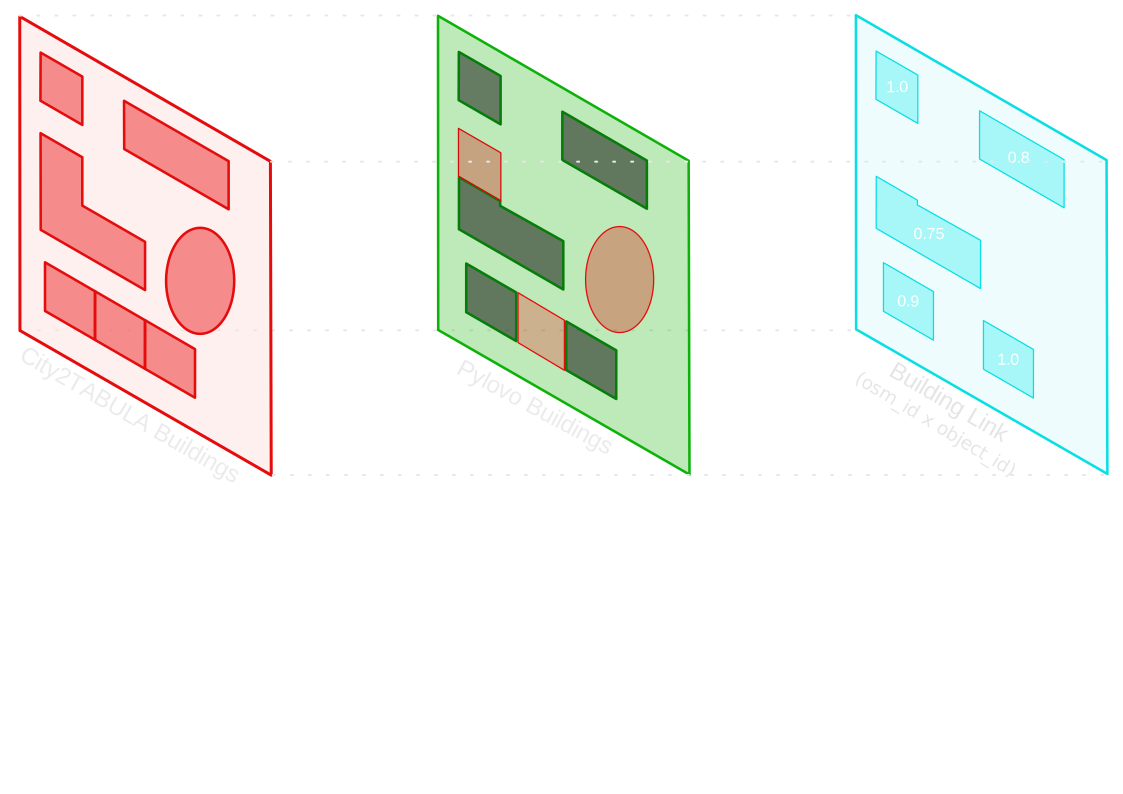
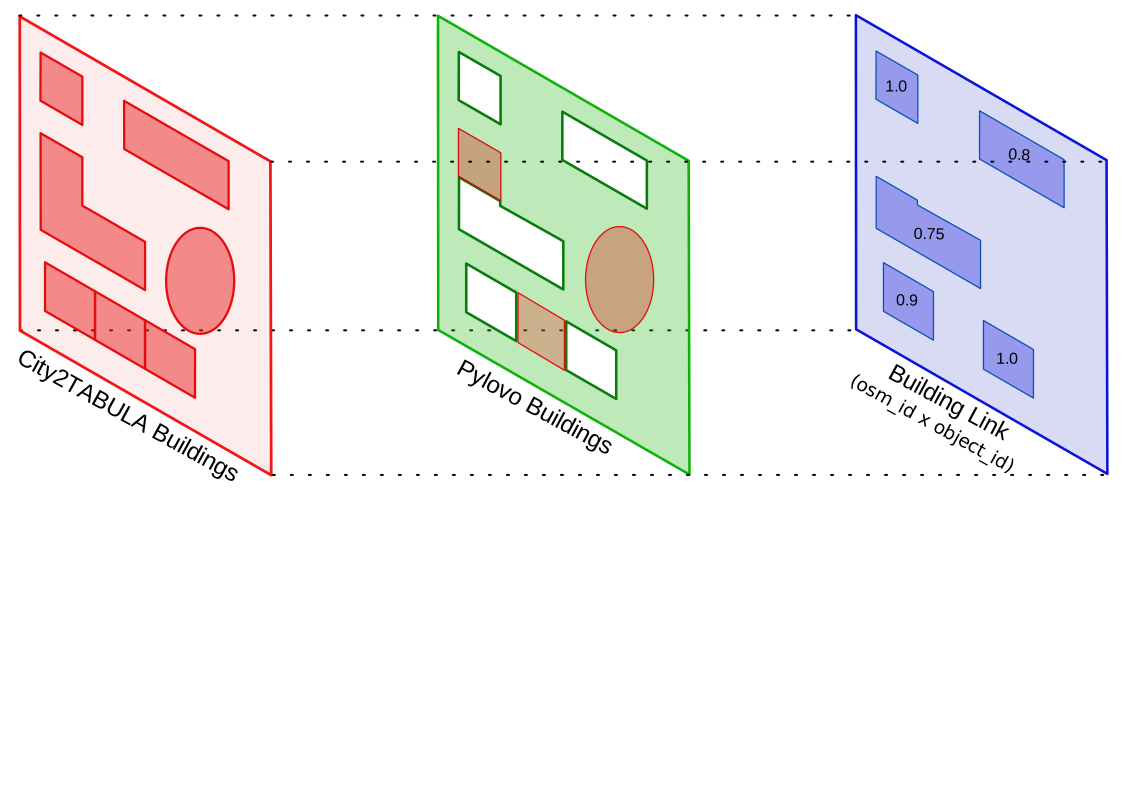
To avoid scanning the full PyLovo database for every batch of 3D buildings, the pipeline uses spatial grid batching: buildings are grouped into 1 km × 1 km cells, and only the PyLovo buildings whose footprint intersects the cell's bounding box are loaded for comparison. This keeps each join small and predictable regardless of the total number of PyLovo buildings.
flowchart TD
    A[("lod2_building<br>3D footprints + object_id")]
    B["getGridBatches<br>Divide buildings into<br>1 km × 1 km grid cells"]
    C["batch_bbox<br>Bounding box of cell<br>transformed to EPSG:3035"]
    D[("pylovo.res<br>pylovo.oth<br>OSM buildings")]
    E["res_subset / oth_subset<br>Pre-filtered + pre-transformed<br>to native 3D CRS"]
    F["IoU join<br>ST_Intersection area /<br>smaller footprint area"]
    G{{"IoU ≥ 0.5?"}}
    H["match_type = 1 for the best way<br>match_type = 4 for each further way<br>object_id + osm_id"]
    I["match_type = 2<br>3D only<br>no OSM match found"]
    J[("city2tabula.building_link")]

    A --> B
    B --> C
    C --> E
    D -->|ST_Intersects bbox| E
    A --> F
    E --> F
    F --> G
    G -->|yes| H
    G -->|no| I
    H --> J
    I --> J
Running the link step
Feature extraction must have run first so that lod2_building is populated with footprint geometries.
# Link buildings that have no building_link row yet
./c2t -link-pylovo

# Re-link every building, e.g. after the PyLovo data changed
./c2t -link-pylovo -relink
-link-pylovo skips buildings that already have a building_link row, so a run after a small import links only the new buildings. When every building is already linked it reports that and changes nothing. -relink recomputes the links of all buildings against the current PyLovo data.
Configuration
| Variable | Default | Description |
|---|---|---|
PYLOVO_SCHEMA |
public |
Schema holding local res and oth tables. Ignored when PYLOVO_FDW_HOST is set. |
PYLOVO_LINK_GRID_SIZE |
1000 |
Grid cell side length in metres. Smaller values give tighter pre-filtering but create more jobs. |
Set these in .env alongside the existing database variables. For a
central PyLovo database on a separate server, see Federated setup.
Federated setup (postgres_fdw)
Under the database-per-country layout each country's City2TABULA database is
separate, so pylovo.res / pylovo.oth are not in the same database and cannot
be joined directly. Setting PYLOVO_FDW_HOST makes -link-pylovo reach the
central PyLovo database through
postgres_fdw:
each run drops and recreates the foreign server pylovo_srv, a user mapping for
the connecting role, and schema pylovo holding foreign tables res and oth.
A changed host or credential in .env takes effect on the next run with no
manual SQL.
Leave PYLOVO_FDW_HOST empty to read res / oth as local tables in
PYLOVO_SCHEMA instead (single-database deployments, tests).
Prerequisites
| Requirement | Where | Note |
|---|---|---|
PostgreSQL with postgres_fdw |
City2TABULA database server | contrib module, ships with standard PostgreSQL |
PostGIS, and res / oth in schema public |
PyLovo database | IMPORT FOREIGN SCHEMA reads public |
Network route to PYLOVO_FDW_HOST:PYLOVO_FDW_PORT |
from the City2TABULA database server | postgres_fdw connects server to server, not from where c2t runs |
DB_USER may run CREATE EXTENSION / CREATE SERVER |
City2TABULA database | superuser, or a role granted USAGE ON FOREIGN DATA WRAPPER postgres_fdw |
PyLovo side (once)
Create a read-only login for City2TABULA on the PyLovo database:
CREATE ROLE c2t_fdw_reader LOGIN PASSWORD '<strong-password>';
GRANT CONNECT ON DATABASE <pylovo_db>   TO c2t_fdw_reader;
GRANT USAGE   ON SCHEMA public          TO c2t_fdw_reader;
GRANT SELECT  ON public.res, public.oth,
                 public.spatial_ref_sys TO c2t_fdw_reader;
res and oth are the only tables read; spatial_ref_sys is needed for the
CRS transform in the link query.
City2TABULA side
Add to .env:
| Variable | Value |
|---|---|
PYLOVO_FDW_HOST |
PyLovo host, resolvable from the City2TABULA database server |
PYLOVO_FDW_PORT |
PyLovo port (default 5432) |
PYLOVO_FDW_DBNAME |
PyLovo database name |
PYLOVO_FDW_USER |
c2t_fdw_reader |
PYLOVO_FDW_PASSWORD |
the role's password |
c2t exits on start if PYLOVO_FDW_HOST is set but any of dbname, user, or
password is missing.
Run and verify
-- foreign tables reachable
SELECT count(*) FROM pylovo.res;
SELECT count(*) FROM pylovo.oth;

-- link result
SELECT match_type, count(*) FROM city2tabula.building_link GROUP BY match_type;
Teardown
-- City2TABULA database
DROP SERVER pylovo_srv CASCADE;
DROP SCHEMA pylovo;

-- PyLovo database
DROP ROLE c2t_fdw_reader;
Notes
- One
pylovo_srvper City2TABULA database; each country database sets it up on its own-link-pylovorun. - The user mapping is
FOR CURRENT_USER, i.e. theDB_USERrole. If a different role runs-link-pylovo, run it once as that role to create the mapping. res/othhold every country. Each batch reads only rows whosecountry_codematches the run's country and whose geometry intersects the batch's EPSG:3035 bounding box, so a shared multi-country PyLovo database is fine.- Both conditions run on the PyLovo side, where its GiST index on
geomand btree index oncountry_codeanswer them.EXPLAIN VERBOSEon the link query shows them in the foreign scan'sRemote SQL. PYLOVO_FDW_PASSWORDlives in.env(gitignored). Rotate it as the deployment's security policy requires; the tool re-applies it on the next run.
Output: city2tabula.building_link
One row per pair of 3D building and matched OSM way, and one match_type 2 row for a 3D building with no match. Only buildings with a footprint geometry and a valid object_id are linked. Re-running -link-pylovo adds rows for new buildings only; -link-pylovo -relink replaces the rows of every building (see Running the link step). A table created by an earlier release, unique per 3D building, is updated to this shape on the next link run.
| Column | Type | Description |
|---|---|---|
object_id |
VARCHAR(100) |
Stable 3D city model identifier (supports CityGML and CityJSON) |
osm_id |
TEXT |
PyLovo OSM building identifier, NULL when no match |
pylovo_table |
VARCHAR(3) |
res (residential) or oth (commercial/public/industrial), NULL when no match |
match_type |
SMALLINT |
See match types below |
match_confidence |
DOUBLE PRECISION |
IoU score 0–1; NULL when no match |
country_code |
CHAR(2) |
ISO 3166-1 alpha-2 code derived from the COUNTRY env var (e.g. DE, NL) |
geom |
GEOMETRY(MultiPolygon) |
3D footprint in native source CRS |
srid |
INTEGER |
SRID of geom (e.g. 25832 for Germany) |
Match types
| Value | Meaning |
|---|---|
1 |
Complete: 3D building matched to an OSM building. All attributes available. |
2 |
3D only: no OSM building found within IoU threshold. OSM attributes must be inferred. |
3 |
OSM only: an OSM building with no 3D counterpart. Populated separately, not by this pipeline. |
4 |
Further OSM way of a 3D building whose best way is its match_type 1 row. |
Extending to other data sources
The link pipeline is designed for one data source per subdirectory under sql/scripts/link/:
A future OGR2OGR-based OSM import would add a parallel subdirectory (ogr2ogr/) with its own script and a new -link-ogr2ogr flag, with no changes to the existing pipeline.
Pre-requisite
res and oth must be populated by the enerplanet-pylovo/datapipeline before running -link-pylovo, either as local tables in PYLOVO_SCHEMA or in the central database named by PYLOVO_FDW_*. The link step reads their osm_id, country_code and geom (EPSG:3035) columns and does not modify them.